Most people have a vague sense that something is out of balance long before they can explain what it is. Life continues on the surface. They go to work. They answer emails. They maintain relationships. They meet obligations. From the outside, things may even appear successful.
But internally, something feels off.
There is often a low-level dissatisfaction that follows them through the day — difficult to articulate, but impossible to ignore once noticed. They feel tired in a way that sleep does not solve. Rest weekends do not restore them. Achievements land without the satisfaction they expected. Goals they worked hard for feel strangely empty once attained.
This experience is more common than most people realise.
Many adults are not in crisis. They are simply disconnected from parts of their lives that once made them feel grounded, purposeful or fully alive. The problem is that vague dissatisfaction is difficult to address because vagueness offers no clear direction. You cannot improve what you cannot accurately see.
That is where the Wheel of Life becomes useful.
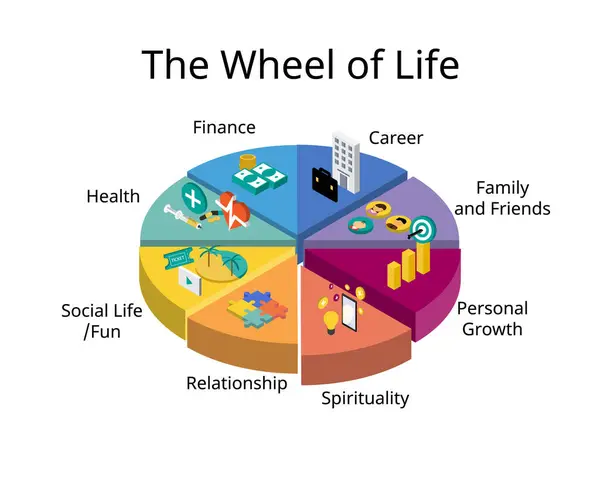
The Wheel of Life is a simple but powerful reflective tool used in coaching, counselling, leadership development and therapy. It does not diagnose problems or prescribe solutions. Its purpose is more practical than that. It helps people see their lives clearly — often for the first time in a long while.
And clarity changes things.
Where the Wheel of Life Comes From
The Wheel of Life is most commonly attributed to Paul J. Meyer, who developed the concept in the 1960s during his work on personal growth, goal-setting and life satisfaction. Over time, the framework spread far beyond the self-development world and became widely adopted by therapists, executive coaches, psychologists and wellness practitioners.
Its staying power comes from its simplicity.
Rather than asking someone to analyse every detail of their life, the Wheel of Life asks a much more manageable question:
How satisfied are you, really, in the major areas of your life right now?
Not how successful you appear.
Not how grateful you think you should be.
Not how your life compares to someone else’s.
Just: how satisfied are you?
That distinction matters more than people initially realise.
Many people are objectively functional while subjectively exhausted. Others appear outwardly successful but feel emotionally disconnected from the lives they built. The Wheel of Life helps surface those discrepancies in a visual and emotionally honest way.
Often, people discover that the story they have been telling themselves about their lives does not fully match their lived experience.
Why People Avoid Looking Closely
One reason the exercise is so effective is that many people rarely pause long enough to evaluate their lives intentionally.
Modern adult life encourages maintenance, not reflection.
People move from one demand to another:
deadlines,
family obligations,
financial pressure,
notifications,
responsibilities,
recovery,
repeat.
In that environment, it becomes easy to confuse movement with alignment.
Someone can spend years optimising productivity while quietly neglecting meaning, relationships, rest or emotional wellbeing. Another person may invest heavily in career progression while their physical health deteriorates slowly in the background. Someone else may maintain stability for everyone around them while becoming increasingly disconnected from themselves.
None of these problems appear overnight. That is partly why they are difficult to recognise.
Imbalance usually accumulates gradually.
The Wheel of Life interrupts autopilot long enough for someone to ask:
What is actually happening in my life right now?
Not theoretically.
Not eventually.
Now.
The Eight Dimensions
Your Wheel of Life.
Rate how satisfied you feel across eight dimensions of life — then see what the shape of your wheel reveals about where to focus next.
At Ituura Wellness, the Wheel of Life is structured around eight major dimensions that reflect the core domains of adult wellbeing.
Each dimension represents an area that significantly shapes overall life satisfaction.
Career
Career is not simply employment status or income level. It includes your sense of progress, competence, purpose and fulfilment in your professional life.
A person may have a prestigious role and still feel trapped, disconnected or emotionally drained by their work. Another may earn less but feel deeply aligned with what they do each day.
Career dissatisfaction often shows up first as chronic fatigue, irritability or emotional numbness before people consciously recognise it.
Questions worth considering include:
- Does your work feel meaningful?
- Are you growing or stagnating?
- Does your career support the kind of life you actually want?
- Are you constantly depleted by your work environment?
Finances
Financial wellbeing is not only about income. It is about security, control and emotional relationship to money.
Two people earning the same amount can experience completely different levels of financial wellbeing depending on debt, stability, financial literacy, lifestyle expectations and anxiety.
Someone with a high income but no sense of control may feel chronically stressed. Someone earning modestly but living within their means may feel relatively secure and calm.
Financial dissatisfaction often creates psychological pressure that spills into every other area of life.
Health
Health includes physical wellbeing, energy, sleep, nutrition, movement and the general condition of the body.
Many people adapt to low energy gradually and begin treating exhaustion as normal adulthood. They stop noticing how disconnected they have become from basic physical wellbeing until their body forces the issue through illness, burnout or chronic stress symptoms.
Health scores are often revealing because people frequently neglect themselves while continuing to function externally.
The question is not simply:
Are you ill?
The deeper question is:
Are you caring for your body in a sustainable way?
Relationships
This dimension focuses on emotional connection and relational quality.
Human beings are relational by nature, but loneliness does not only happen in isolation. People can feel profoundly disconnected while surrounded by others.
Healthy relationships involve trust, emotional safety, mutual support and honest connection. Dysfunctional or neglected relationships often create a background emotional strain that affects everything else.
A low score here may reflect conflict, emotional distance, isolation or the absence of meaningful connection altogether.
Family
Family relationships deserve separate attention because they carry unique emotional weight and complexity.
Even when adult life becomes independent, family dynamics often continue shaping identity, stress levels and emotional wellbeing. Responsibilities toward parents, children or extended family can become major sources of either support or pressure.
This category invites honest reflection about:
- boundaries,
- emotional closeness,
- unresolved tension,
- caregiving burdens,
- and whether family relationships feel healthy or draining.
Growth
Growth refers to learning, development and the feeling that you are evolving as a person.
People stagnate psychologically when life becomes entirely maintenance-based. Without growth, many begin experiencing emotional flatness, boredom or quiet hopelessness.
Growth can involve:
- education,
- creativity,
- therapy,
- spiritual exploration,
- skill-building,
- reading,
- reflection,
- or expanding your understanding of yourself and the world.
A healthy life generally requires movement, not just stability.
Fun
Fun is one of the most underestimated dimensions of wellbeing.
Adults often deprioritise joy first.
Play, rest, spontaneity and enjoyment are frequently treated as luxuries instead of psychological necessities. Over time, life becomes purely functional. People become efficient but emotionally dry.
A very low Fun score is common among high-performing adults.
And yet, without restorative experiences, people eventually lose emotional resilience. Everything begins to feel heavy. Relationships suffer. Motivation declines. Burnout accelerates.
Fun is not frivolous.
It is part of psychological sustainability.
Purpose
Purpose reflects meaning, values alignment and connection to something larger than immediate survival or achievement.
This dimension asks:
Does your life feel meaningful to you?
Not performative.
Not impressive.
Meaningful.
Purpose often becomes especially important during transitions, grief, burnout or periods of existential questioning. Many people discover that external success cannot compensate for a persistent absence of meaning.
Purpose does not need to look grand or dramatic. For some people it emerges through parenting, service, creativity, faith, community or contribution. What matters is the sense that your life connects to something that genuinely matters to you.
How to Do the Exercise Honestly
The Wheel of Life only works when approached honestly.
That sounds obvious, but many people instinctively rate aspirationally instead of truthfully. They rate based on where they think they should be, where they hope to be soon, or what would look reasonable to others.
That defeats the purpose.
Each dimension is rated on a scale from one to ten:
- One means deeply dissatisfied.
- Ten means genuinely fulfilled.
- Five usually means acceptable but with clear room for improvement.
The key is intuitive honesty.
Do not overanalyse every number. Your first instinct is usually more accurate than the polished explanation your mind creates afterward.
A useful question is:
If I were being completely honest with myself, how satisfied am I in this area right now?
Not objectively successful.
Not comparatively fortunate.
Satisfied.
Those are different measurements entirely.
Someone may objectively have a stable marriage while feeling emotionally lonely inside it. Another may have financial stability but constant anxiety around money. A person may be physically healthy yet deeply disconnected from meaning or joy.
The Wheel of Life measures lived experience, not appearances.
What the Wheel Often Reveals
Many people expect the exercise to confirm what they already know.
Sometimes it does.
But often, the visual pattern reveals something more uncomfortable:
the areas receiving the most attention are not necessarily the areas creating the most fulfilment.
Someone may realise they have spent years maximising career achievement while neglecting relationships and health. Another may discover that their exhaustion has less to do with workload and more to do with a total absence of rest, fun or meaning.
The exercise can also expose hidden compensation patterns.
For example:
- Overworking to avoid emotional discomfort
- Pursuing achievement to compensate for low self-worth
- Constant busyness to avoid loneliness
- Caretaking others while neglecting personal needs
- Chasing productivity instead of fulfilment
The Wheel does not diagnose these dynamics directly. But it often makes them visible enough to explore honestly.
Reading Your Wheel
Once all eight dimensions are rated, the scores create a visual shape.
That shape matters.
The Lowest Dimension
The lowest-rated area is often the most informative.
Not because it is automatically the most important part of life, but because neglected areas create friction across everything else.
Someone with a severely depleted Health score may struggle to sustain performance at work. Someone with almost no Fun or rest may notice worsening irritability in relationships. Someone disconnected from Purpose may find achievement increasingly empty no matter how successful they become.
Low areas tend to leak into adjacent domains.
The Wheel helps make those connections visible.
The Shape of the Wheel
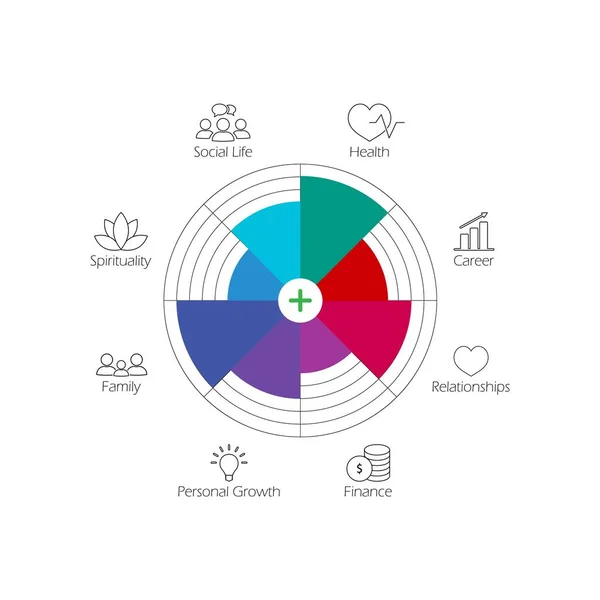
Very uneven wheels are common.
Someone may score:
- Career: 9
- Finances: 8
- Health: 3
- Relationships: 4
- Fun: 2
Externally, this person may appear highly successful. Internally, life may feel unsustainable.
A wheel with dramatic imbalance creates a rough ride psychologically. The goal is not perfection across every category. Human lives naturally fluctuate. The aim is greater overall stability and sustainability.
A smoother wheel tends to support resilience better than a highly fragmented one.
The Gap Between Present and Desired
Many therapists and coaches ask clients to complete two wheels:
- Life as it currently is
- Life as they want it to be
The gap between those two wheels becomes extremely valuable information.
It highlights:
- unmet needs,
- neglected values,
- unrealistic expectations,
- emotional deprivation,
- and where change would have the greatest impact.
This gap often explains why people feel persistently dissatisfied despite functioning well externally.
What to Do With What You Learn
The Wheel of Life is not a solution. It is a diagnostic mirror.
What matters is what happens after the insight.
For some people, the exercise simply confirms something they already knew but had avoided admitting clearly. That alone can be powerful. Naming a problem accurately often reduces confusion and helplessness.
For others, the exercise creates surprise.
The area they assumed was fine turns out to be deeply neglected. An area they dismissed as unimportant turns out to be central to their wellbeing.
The next step is not immediate life overhaul.
It is targeted awareness.
Instead of attempting to fix everything simultaneously, the more effective approach is usually identifying one or two dimensions where small, sustainable improvements would create meaningful overall change.
For example:
- improving sleep consistency,
- rebuilding neglected friendships,
- setting financial boundaries,
- reconnecting with hobbies,
- reducing overwork,
- beginning therapy,
- or creating space for reflection.
Small adjustments in neglected areas often create disproportionate improvements elsewhere.
Why the Wheel Is Useful in Therapy and Coaching
In therapeutic and coaching settings, the Wheel of Life is valuable because it externalises internal experience.
Many people arrive in therapy saying:
“I don’t know what’s wrong.”
“I just feel off.”
“I should be happier than this.”
The wheel gives structure to that ambiguity.
It helps identify patterns, contradictions and neglected priorities without forcing immediate conclusions. It also creates a non-judgemental framework for conversation. Instead of focusing only on symptoms or crises, the discussion expands into broader questions about values, meaning, balance and sustainability.
Importantly, the wheel also helps track progress realistically.
Change is rarely linear. Improvement in one area may temporarily lower another. Someone healing from burnout, for example, may improve Health and Purpose while temporarily reducing Career intensity.
The wheel captures those shifts more accurately than vague emotional memory does.
Using the Tool Over Time
The Wheel of Life becomes more valuable when used repeatedly rather than once.
Revisiting it every three to six months creates longitudinal insight into how your life is actually evolving.
Memory is unreliable. Mood distorts perception. People tend to either romanticise the past or catastrophise the present depending on their emotional state.
The wheel creates a more grounded record.
This becomes especially useful during:
- career transitions,
- grief,
- relationship changes,
- parenting shifts,
- burnout recovery,
- health challenges,
- or major identity transitions.
Over time, patterns emerge.
You begin noticing:
- which areas consistently deteriorate under stress,
- what restores you most effectively,
- where your blind spots tend to be,
- and which dimensions have the greatest influence on overall wellbeing.
That awareness is valuable because sustainable wellbeing is rarely accidental. It usually requires periodic recalibration.
The Point Is Awareness, Not Perfection
One of the most important things to understand about the Wheel of Life is that it is not about achieving perfect balance.
No adult life remains evenly balanced at all times.
Some seasons demand more attention to work. Others require focus on health, family or recovery. Balance is dynamic, not static.
The real danger is unconscious imbalance — living so automatically that entire dimensions of life deteriorate unnoticed for years.
The Wheel interrupts that drift.
It creates a pause long enough to ask:
What kind of life am I actually building?
And does it still align with who I want to become?
Those questions matter.
Because people do not usually burn out suddenly. Relationships rarely collapse without warning. Meaninglessness does not arrive overnight.
Most forms of dissatisfaction accumulate quietly while attention is elsewhere.
The Wheel of Life helps bring those quiet patterns into view before they become crises.
You can explore the interactive Wheel of Life tool through Ituura Wellness. The process takes only a few minutes but can reveal far more than people expect. If the exercise surfaces deeper questions about balance, fulfilment or emotional wellbeing, the free five-question assessment available there can help identify the next area worth exploring.